Trevor Grandin / 23 Nov 2026 / Guadalcanal Honeyeater
High in the mountain forest of Guadalcanal, Swiss birder Julien Mazenauer is waiting to snap a photo of a mythical creature. As a tour leader with Ornis Birding Expeditions, Mazenauer is one of the few birders who have seen a Moustached Kingfisher (Actenoides bougainvillei) in person. But a photo of the kingfisher wouldn’t be Mazenauer’s first major find of the trip. Less than 12 hours earlier, Mazenauer and his group recorded the vocalizations of a species that’s been lost to science for over a decade.
This is the wonder of Guadalcanal, the largest island in the nation of Solomon Islands. A place where someone can record the song of the Guadalcanal Honeyeater (Guadalcanaria inexpectata) one day, catch a glimpse of the Moustached Kingfisher the next and see countless rare birds along the way—some of which were photographed for the first time last year.
Turned Back
Touching down on Solomon Islands in late July, the group planned to start their 35 day birding trip on Guadalcanal’s Mount Pompanaseau. As the tallest mountain in the Solomons, the 2,300 meter climb is the perfect place to spot some of the island’s high-altitude endemic birds.
Like most birding spots throughout the island, Mount Popomanaseu is accessed by a local trail. The group’s starting point was behind an active gold mine at the base of the mountain, but when Mazenauer and his group arrived at the mine’s entrance, they were turned away. Just hours before their arrival, a landslide had raced down the mountain, spilling into the gold mine and burying multiple people underneath the rubble.
Already, Guadalcanal is a tough environment to traverse. The dense rainforest and rough terrain make the use of community knowledge and trails a necessity. Inclement weather can swell rivers at a moments notice, blocking a path that may have been open hours ago. In fact, a few days after Mazenauer and his party were turned away at the mine’s entrance, heavy rains stranded a pair of hikers from New Zealand on the mountainside for six days.
Alongside tense tribal relations and prolonged civil conflict, these reasons make the highlands of Guadalcanal one of the hardest areas in the region for ornithologists to research. Species like the Guadalcanal Fantail and Guadalcanal White-eye were only photographed for the first time in 2025 on an Ornis Birding Expedition led by Joshua Bergmark. Other species have yet to be rediscovered, like the Guadalcanal Thicketbird, which was last documented 55 years ago in 1971, or are nearly lost like the Guadalcanal Thrush, which was last photographed by Thierry Quelennec in 2016 meaning that it could become a lost bird next year.
The group decided to change their plans. With the local community still reeling from the disaster, Mazenauer knew now was not the time to climb Mount Popomanaseu. After island hopping across the Solomons, the group would return to Guadalcanal at the end of their trip for a second try.
Take two
On August 22, almost a month after their first attempted ascent, Mazenauer and the group walked through the gold mine’s gates and started the hike to base camp. A village about 900 meters up the mountain was their first stop. Though the community was still recovering from the recent tragedy, they were eager to welcome in the group. A recently built guesthouse would act as the group’s return point after each day of birding.
By 10 a.m. the next day, the group had made the steep and slippery climb up to the summit of a nearby ridge, about 1,300 meters above sea level. They had seen a handful of the island’s high-altitude birds on the way up, such as the Guadalcanal Hooded Whistler and the Guadalcanal Fantail. Mazenauer knew that the group needed to get as high as possible on the mountain to increase their likelihood of spotting some of Guadalcanal’s rarest birds.
Around 11 a.m., Mazenauer heard a call that would pique the interest of any seasoned birder. Deep within an adjacent gully came a churring call he recognized quickly: the elusive Moustached Kingfisher. Scanning with their binoculars, the group searched the lower canopy for the bird to no avail.
That’s when Mazenauer was reminded of a similar experience he had on an island north of Guadalcanal. In 2025, Mazenauer and colleague Joshua Bergmark captured some of the first photos of the Moustached Kingfisher in the wild while exploring the forests of Bougainville. The birds there were a different subspecies from the ones on Guadalcanal but undoubtedly had similar calls and behavior. It had been much easier to find the bird during twilight, he remembered. Though little is known about the Moustached Kingfisher, it is believed they are crepuscular, or most active during dawn and dusk. Others suggest the bird might even be fully nocturnal.
Midmorning would not be the ideal time to see the Moustached Kingfisher, so Mazenauer made the difficult decision to call off the search and wait till tomorrow. The group would have another half-day of birding, before catching their international flights from the capital city. “I didn't think we had much chance to see it during the misty afternoon,” Mazenauer said. “We just left it and hoped for the best, for the weather to be nice in the morning.”
Leaving the kingfisher call behind, the group continued their push up the mountain ridge, until they heard another strange call erupt from a nearby thicket. Then suddenly, two birds dashed into view and settled on a nearby branch. If the calls hadn’t given them away, the sightings confirmed that the group was looking at a pair of Guadalcanal Honeyeaters.
Many members of the honeyeater family (Meliphagidae) have a slight curve to their bill. The birds use their brush-tipped tongues to lap up nectar from flowering plants, while pollinating the blooms along the way. Now certain of the bird’s identities, Mazenauer took out his phone, pressed record and captured audio of the pair’s chatter.
Just as quickly as they appeared, the pair of honeyeaters flitted off into the brush, their bright yellow neck patches and greyish bodies streaking down the trail. The group was at the whim of the birds; a lack of flowering forest plants during that time of year meant the group was unable to watch them feed. Mazenauer followed the pair’s whining squawks and squeaks through the brush.
Neither Mazenauer nor other members of the expedition were able to photograph the Guadalcanal Honeyeaters. However, the group did walk away with an audio recording, which when the bird’s vocalizations are known is just as valuable in confirming an identification as a photo. In the case of the Guadalcanal Honeyeater, the species had been recorded on several occasions in 2015, providing comparative material for Mazenauer’s new recording.
In the montane forests of Guadalcanal, the honeyeater’s “per-twee, per-twee” couldn’t be confused with any other species. “It’s really the only thing that calls like this,” Mazenauer said. “I saw basically where the call came and there were no other birds. And it matches the previous recordings as well. So there’s no doubt for me.”
With one rediscovery under his belt, Mazenauer’s mind couldn’t help but wander back to the tantalizing call he’d heard earlier in the day. That’s when he knew for sure he’d be back on the mountain very soon to find the Moustached Kingfisher.
Wake up call
Mazenauer’s alarm clock rang out at 1 a.m the next morning, and the group made the two-and-a-half hour trek up the mountain. In hopes of finding a Moustached Kingfisher in the pre-dawn darkness, Mazenauer used a thermal imaging camera to scan the forest. Peering into the gully where the bird had called from yesterday, he saw nothing. The group would have to do this the old fashioned way.
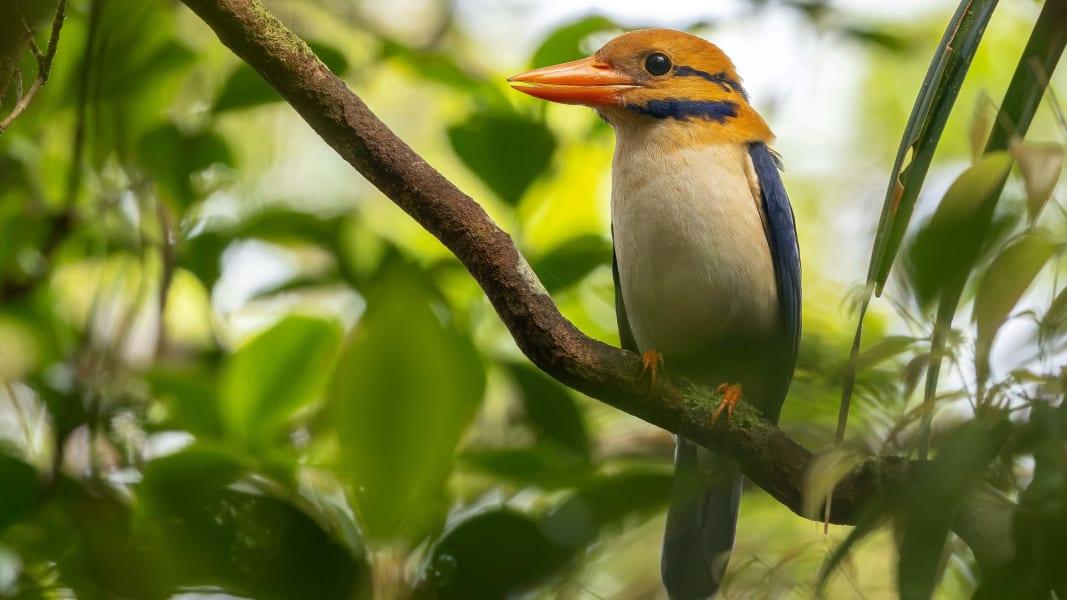
Mazenauer situated himself within the gully, and played a recording of the kingfisher that had been made when the bird was last documented back in 2015 hoping that he might get a response. As night turned to dawn, the fog rising into the canopy, a bolt of blue zipped onto a nearby tree branch. A small but mighty creature with a bill as orange as a traffic cone sat patiently waiting for its closeup. The sound of camera shutters radiated from the gully. The Guadalcanal subspecies Moustached Kingfisher had just been documented for the first time since 2015.
In 2024, Mazenauer was part of the team that found the Bougainville subspecies of the bird. Before that, sightings of the Moustached Kingfisher were fragmented, including photographs of a dead individual and reports of the bird’s song ringing through the forest. Having now found the Guadalcanal subspecies of this elusive kingfisher, Mazenauer now had the unique distinction of one of the only people, perhaps the only person, to have seen both subspecies of this fabled ‘ghost bird.’
As fast as the kingfisher arrived, Mazenauer watched it flit away into the forest with a burst of blue and orange. At this moment, he realized his camera was not one of the lucky ones to catch a photo of the bird. The humid forest, saturated by rain the night before, had started to fill with fog. As the fog crept along the forest floor, it clung to Mazenauer’s camera lens, obscuring his view. Thankfully, one of the group members had taken excellent photographs of the kingfisher before it flew off. Mazenauer took his own photos of the kingfisher when it appeared again further down the trail.
Within a 12 hour period, Mazenauer and his group had gotten the first photographs of the Guadalcanal subspecies of Moustached Kingfisher in over a decade and rediscovered the Guadalcanal Honeyeater.
Every day on Guadalcanal felt just as full of possibility as the last. “It’s like exploring the unknown,” Mazenauer continued, “There’s been so few birders up in the highlands of Guadalcanal.” Ornis Birding Expeditions plans to continue searching for more lost birds in the Guadalcanal highlands very soon. The group is planning an expedition for 2027 that’ll go even higher on Mount Popomanaseu in search of the kingfisher, honeyeater and other birds on the island. With any luck, they might even find Guadalcanal’s last remaining lost birds, the Guadalcanal Thicketbird.
Guadalcanal continues to be one of the least understood locations in ornithological research. But bird by bird, the rediscoveries like these made by people like Julien Mazenauer are providing a clearer picture of the species in the Guadalcanal highlands. They remind birders just how much knowledge remains locked within the natural world and, in turn, give them a blueprint for how to unlock it.
Ornis is also partnering again with Search for Lost Birds to offer for a second round of the Ornis x Lost Birds Expedition Grant. The grant, open to birders around the world aged 18-30, will provide up to $5,000 in support for people to go on expeditions to search for one of the species on the lost birds list. Visit the grant website to apply now.
Trevor Grandin is a science journalist reporting from America’s heartland with interests in wildlife, botany, and public land. He’s currently earning an MA in journalism from the University of Missouri.