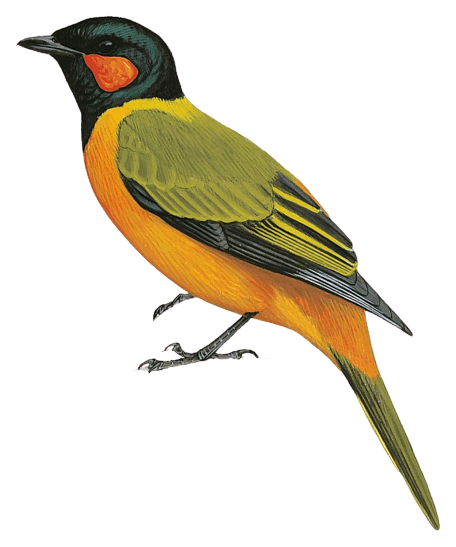
Ghana Cuckooshrike
Lobotos lobatusFAMILY
Cuckooshrikes (Campephagidae)
LAST DOCUMENTED
2013
(13 years)
REGION
Africa
IUCN STATUS
Vulnerable
Background
Colorful but highly elusive, the Ghana Cuckooshrike lives in canopy of lowland forests in West Africa. The species was lost for 13 years between 2013, when an individual was photographed at Atewa Forest, Ghana, and June 2026 when one was photographed and videoed by Stephanie Bartlett and Paulo Ditzel in Taï National Park, Ivory Coast.
Also known as the Western Wattled Cuckooshrike, the Ghana Cuckooshrike differs from the similar Oriole Cuckooshrike or Eastern Wattled Cuckooshrike (Lobotos oriolinus) of central Africa by having an orange-chestnut rump and heavier orange-yellow underparts in the males. Females may be almost indistinguishable from female Oriole Cuckooshrikes.
This species is occurs from eastern Sierra Leone and southwest Guinea through Liberia and the Ivory Coast to Ghana, where it inhabits the Upper Guinea forest zone in the canopy of primary forest, tall lowland rainforest, or in open swamp forests near rivers. The species has occasionally been reported from logged and/or disturbed forests as well as plantations (such as Terminalia ivorensis and cocoa plantations).
It perches in dense, high foliage (20-50 m above the ground) (Birds of the World) and prefers the canopy of tall trees in lowland rainforest up to 600 m above sea level (Pic de Fon and Mt. Bero forest reserves in Guinea) and 700 m above se level in Atewa, Ghana. In Liberia, the Ghana Cuckooshrike was observed in both primary and logged forest at heights of 30-50 m (IUCN Red List).
Ghana Cuckooshrikes are insectivores that eats caterpillars, grasshoppers, and mantids and regularly joins mixed-species flocks in the forest canopy. They are generally quiet and the species is one of the few birds in the world that has never been sound recorded. Individuals have been reported making a “zit” or “tsik” sound when flying.
This species has been reported breeding in primary and mature logged forest between the months of February and November in Liberia but more information regarding the rest of this bird’s range is lacking (Birds of the World). A nest was found 30 m high in a large Xylopia in logged forest in the Gola Forest in early January where the young were fed damselflies, orthoptera, and larvae. Juveniles were seen in this part of the forest in May. In Taï National Park, a female Ghana Cuckooshrike was seen making a nest on the limb of a Ceiba pentandra in early May (Allport, 1991).
Conservation Status
The Ghana Cuckooshrike has been classified as Vulnerable by the IUCN who made its last assessment in 2018. The species’ population is thought to be declining throughout its range in the Upper Guinea forests in West Africa (even within the Gola Forest which is well preserved). The extent of occurrence for this species is 432,000 km2 with an upper elevation limit of 700 m (IUCN Red List).
For a distribution map of the Ghana Cuckooshrike, click here.
Last Documented
The last documented record of a Ghana Cuckooshrike was a series of photos taken at Atewa Forest (Ghana) by Jeremy Lindsell in 2013.
Prior to that the cuckooshrike was photographed on December 17, 2010, by Ruud Kampf in Kakum National Park (Ghana). Kampf's photos are apparently the first ever taken of the species.
In addition to these photographic records here is a brief summary of sightings of Ghana Cuckooshrikes since the 1970s:
1970s- The bird was seen frequently in the Gola Forest (Sierra Leone). According to reports, G. Field saw the Ghana Cuckooshrike 20 times in 62 days between 1971-1976 in logged areas of the forest (Allport, 1991).
1985- One was seen in Marahoué National Park (Ivory Coast) in November (Demey and Fishpool, 1991).
1988- There was an unconfirmed report of a Ghana Cuckooshrike sighting in southeast Nigeria (Ikpan). Due to the lack of detail of the report combined with the fact that Nigeria lies far outside the Ghana Cuckooshrike’s known range, it is believed that this sighting was most likely a case of mistaken identity with the species’ congener, the Eastern Wattled Cuckooshrike, with whom the bird shares many common physical traits (Birds of the World).
In February, two Ghana Cuckooshrikes were sighted in the Marahoué National Park (Ivory Coast).
In September, one male was seen in a mixed-species flock in large trees above a cocoa plantation near the boundary of Taï National Park (Ivory Coast) (Demey and Fishpool, 1991).
1989- After a five-month survey in the Gola Forest (Sierra Leone), the bird was seen only three times.
There was a reported sighting by M. Taylor in Ghana in the same year but there were no further details.
On January 4-7, 1989, Gary Allport saw two pairs in the Gola North, Gola Forest (Sierra Leone) with one pair nesting and feeding two nestlings (Dowsett-Lemaire and Dowsett, 2008).
1988-1991- After a three-year survey, Dominique Halleux reported the Ghana Cuckooshrike in Macenta (Guinea). She notes that the species is uncommon, associates in high-strata mixed species flocks, and was only seen in the Ziama Forest (also in Guinea) in primary and secondary forest above 800 m (Halleux, 1994).
1992- One sighting in the Ziama Forest (Guinea)
1999- Olivier Lachenaud saw Ghana Cuckooshrikes while he was in Divo (Ivory Coast) between October 31 and November 1. This area has still not been explored thoroughly by ornithologists and is at the limit of evergreen and semi-deciduous forests 50 km west of the Mopri Forest, Ivory Coast. On these two days he saw the bird four times and suggests the species may be common in this area. For two days he saw a small group of Ghana Cuckooshrikes (5-6) at the Djiboua Hotel near Divo city where there were remnants of a cleared forest where only some medium-sized trees remained with an open canopy. The birds fed early in the morning among the foliage between 4-10 m high. They were near blooming Albizzias in a mixed-species flock with Wood Warblers (Phylloscopus sibilatrix) and sunbirds. He saw the birds 10 m away as they seemed to run on slanted or skewed branches (a behavior never before noted in this species). They ran faster than other Cuckooshrikes. He also noted that they fly slowly from tree to tree with their tail half spread out while shouting a tseet-tseet sound that can be heard at a short distance. Other than that, the Ghana Cuckooshrike is a very a silent bird.
The other two times Lachenaud saw the Ghana Cuckooshrike was at a research station by the Centre National de Recherche Agronomique (CNRA or National Center for Agronomic Research) in the Ivory Coast 20 km southwest of the city of Divo. This station had 2,000-2,500 hectares of preserved forest that bordered cacao, coffee, rubber tree, and palm tree plantations. At the edge of a dense forest, two Ghana Cuckooshrikes were in the foliage of a tree (Piptadeniastrum africanum) 10-20 m high where they ate insects in flight like flycatchers. He compared them to a Western Oriole (Oriolus brachyrhynchus) that was nearby. Further from the station he saw three Ghana Cuckooshrikes fly above the forest, perch on a tall tree before disappearing into the foliage. Lachenaud remarked that he read that males of the species have a large orange wattle, a reddish-orange chest and stomach, a red rump, and yellow edges to the primary flight feathers. By contrast, the females have a yellow chest and belly and a green rump. Interestingly enough, the Ghana Cuckooshrikes that Lachenaud saw did not have these characteristics. Some of them at the Djiboua Hotel had the yellow edges but they did not have the orange wattle or the reddish color. Instead, they had a yellow rump. He theorizes that these Cuckooshrikes could have been immature males, males with old plumage, or in eclipse form. The wattle also might expand during breeding season. The ones Lachenaud saw at the CNRA did not have the orange wattle or the red color, raising more questions than answers regarding the Ghana Cuckooshrike’s appearance and behavior (Lachenaud, 2004).
2001- While working as a conservation officer and wildlife ranger in the Bia Conservation Area (BCA) in Ghana, James Pender saw a Ghana Cuckooshrike on April 13. Pender and four laborers were expanding a trail in the BCA into forest with rock outcrops and steep rocky slopes. The trail would link Adwuafua Gate Camp to Kumkumso Camp (north of the reserve). The Ghana Cuckooshrike flew out of a rocky slope. The bird looked like a Black-Winged Oriole (Oriolus nigripennis) at first until Pender noticed the yellow wattle and orange rump. Before Pender’s sighting, the only other sightings of the Ghana Cuckooshrike in Ghana were in 1937, in the Krokosua Hills Forest Reserve near BNP in 1999, and an unconfirmed sighting in the 1980s (Pender, 2013).
2005-2007- In a survey that was conducted from December 2005-March 2007, the Ghana Cuckooshrike was spotted two times by Eric Klop and his team in the southern part of Gola North of the Gola Forest (Sierra Leone) in primary forest and in open-canopy forest near Belebu (close to where the Dowsetts would have their sighting in 2007) (Klop et al., 2010).
2007- The bird was seen twice by Dr. Fraçoise Dowsett-Lemaire and Dr. R.J Dowsett in Gola Forest in the southern part of Gola Central (Sierra Leone) with one male being seen eating alone in a medium-sized tree in a patch of tall forest that was damaged by a hurricane on Ngbonkelekei Hill near Belebu (Dowsett-Lemaire and Dowsett, 2008).
2011- A Ghana Cuckooshrike was sighted near Bonkro, Ghana in April by J. Ntakor.
2013- In addition to the photo taken at Atewa Forest there was also a sighting in Bonkoro (Ghana) (IUCN Red List).
2024-2026- There were a several sightings of Ghana Cuckooshrike from Taï National Park (Ivory Coast), but none of these included accompanying documentation.
Challenges & Concerns
This species is rarely seen and likely declining due to extensive habitat loss as a result of logging and forest clearance in West Africa. In reality, no one knows the real reason why this species is so rare and even less is known about its behavior. As Olivier Lachenaud noted: “If the distribution of this bird is not well-known, its environmental preferences and its behavior are even less so” (Translation from the French by Nick Ortiz). Surveys conducted in the Gola Forest, Sierra Leone, indicated a severe decline in population. Other surveys were conducted in other areas of the bird’s range (such as Ghana) but did not find the species. The bird is rare in Liberia where logging, agriculture, mining, and settlement have eliminated most of the species’ suitable habitat (Birds of the World).
Experts estimate that 77% of the original Upper Guinea Forest was already gone by 1991. Between the years 1984-2004, the Ivory Coast had the highest rate of deforestation in the world with places like Divo (where the Ghana Cuckooshrike was sighted in the late 1990s) being the most affected with only some of the original forest still remaining in isolated pockets. As of now, most of the remaining primary forest is in Liberia and the Ivory Coast which are both countries that are now facing extreme pressure to log these forests. In the Ivory Coast, the forests are protected within the Taï and Marahoué national parks and in Liberia in the Mt. Nimba reserve and in Sierra Leone in the Gola Forest reserve (Lachenaud, 2004). Outside these protected areas, there is even less original forest now since the international timber market is putting a lot of pressure on West African countries to supply wood to meet global demand. This demand has also spurred the rapid expansion of tree and cocoa plantations at the expense of primary forest. There are only two major forest blocks of original forest remaining. The first and largest is in southeast Liberia and southwest Ivory Coast. This area includes Taï National Park and the N'zo Fauna Reserve in the Ivory Coast and the Grebo, Gio, and Krahn-Bassa national forests and Sapo National Park in Liberia (the final four of which have the largest area of remaining unprotected forest). The second forest block is in southeastern Sierra Leone and northwest Liberia. This area includes the Gola forest reserves in Sierra Leone and the Gola-Kpelle-Belle national forests in Liberia (Allport, 1991).
The bird’s range only spans 300,000 sq km with the primary forest in this range getting smaller with every passing year. Outside of Taï National Park, the Ghana Cuckooshrike has been seen in other areas of the Ivory Coast such as Marahoué National Park, Mopri, Mt. Nimba, Mt. Kope, Mopri Forest, Bossematie Forest, and the Haute Dodo Forest Reserve. In Guinea, the species was seen in the Pic de Fon and Mt. Bero forest reserves. In 1997, experts estimated that only 20,000 pairs were still alive. Some experts argue, however, that this may be an overestimate since the species might have disappeared from suitable habitats or because the overall population has experienced a severe decline (IUCN Red List). The current population size of the Ghana Cuckooshrike is unknown but it is most likely considerably smaller due to higher rates of habitat loss over the years.
Taxonomy
Also known as the Western Wattled Cuckooshrike. The species’ original name was Campephaga lobata until it was later updated to Lobotos lobatus.
Page Editors
- John C. Mittermeier
- Nick Ortiz
Species News
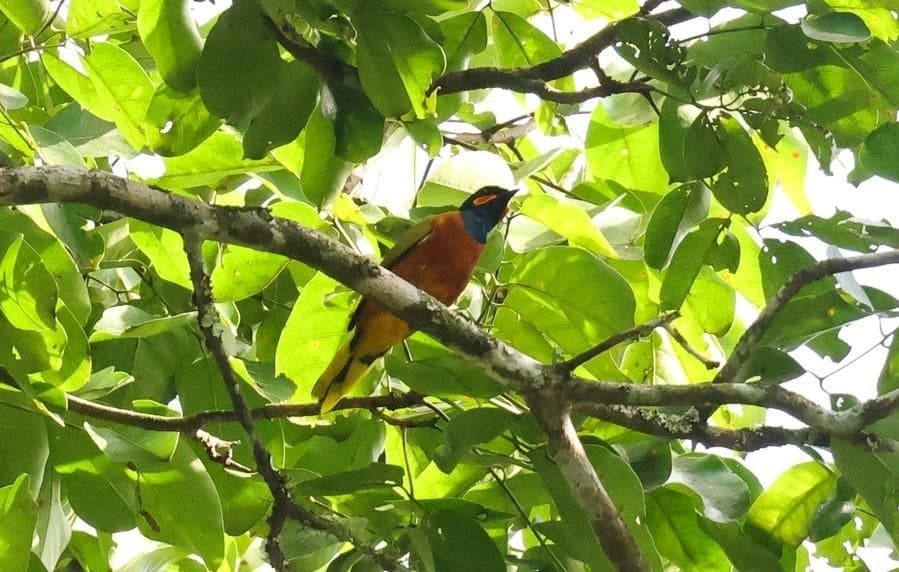
FOUND: Ghana Cuckooshrike documented for the first time in 13 years
John C. Mittermeier / 20 Jul 2026
Read MoreStephanie Bartlett and Paulo Ditzel, researchers with the International Bird Conservation Partnership (IBCP), had joked about the possibility of encountering a Ghana Cuckooshrike during their six-month project in West Africa, but the chances of actually finding one had seemed vanishingly small. The cuckooshrike was one of the most rarely seen birds in Africa and there had been no documented records of it since 2013.
That all changed one afternoon in the forest in Taï National Park, a large park in the southwestern Ivory Coast. Bartlett and Ditzel were crossing a small bridge when a flicker or movement in the canopy caught their attention. As they peered into the dense foliage, they immediately recognized the unique combination of yellow, orange, and black on the bird above them. “Cuckooshrike, cuckooshrike, cuckooshrike!” Bartlett had her camera ready and snapped a series of photos and even a short video clip of the bird before it disappeared a few moments later. It was the first documented recorded of a Ghana Cuckooshrike since one had been photographed at Atewa Forest, Ghana, thirteen years earlier and the likely the first-ever video taken of the species.
To learn more Bartlett and Ditzel’s incredible sighting, read the full story on the International Bird Conservation Partnership website: https://www.birdpartners.org/post/lost-bird-found-ghana-cuckooshrike-documented-in-taï-national-park-ivory-coast
Found only in canopy of the West Africa’s lowland rainforest, the Ghana Cuckooshrike, also known as the Western Wattled Cuckooshrike, is considered globally Vulnerable by the IUCN Red List.
Following the rediscovery of Rusty Lark in Chad in February 2026 and Togo Yellow-billed Barbet in January 2022, all of the currently lost birds in West Africa have now been found – an incredible result!
Support The Search for Lost Birds
Donations from supporters like you make expeditions, science, and conservation possible. Help support the Search.